- Home
- About Us
- Products
- FAQ
- News
- Contact Us
 Hunting And Shooting Bag LSH
 Tactical Military Bag & Vest LST
 Archery Bag LSC
 Fishing Bag LSF
 Others LSB
Want to start with us? Contact us
Leave Your Message
- Phone
- E-mail
- WhatsApp

- WeChat

Choosing the best China Military Courier Bag supplier requires more than comparing prices. It requires evidence, testing, and practical communication. A reliable supplier should understand secure document transport, field durability, and professional procurement requirements. Their bags should use abrasion-resistant fabric, reinforced stitching, dependable zippers, and clear identification panels. Small details matter.
Look closely at production experience. Ask for factory photographs, material specifications, inspection records, and recent sample results. A capable manufacturer can explain fabric weight, seam construction, load capacity, and water-resistant treatment without vague promises. Independent audits and consistent quality-control procedures also strengthen supplier credibility. Sample orders are essential. They reveal uneven stitching, weak handles, poor printing, or uncomfortable shoulder straps before larger production begins.
No supplier is perfect. That deserves honest attention. A factory may offer excellent materials but slower communication. Another may deliver quickly but provide limited customization. The best choice depends on your quantity, budget, delivery schedule, and quality expectations. Request a written quotation with clear specifications, packaging details, lead times, and after-sales support. Confirm that all products follow applicable trade, safety, labor, and environmental requirements. Responsible sourcing protects your organization and improves long-term reliability.
This guide examines how buyers can assess China-based manufacturers with confidence. It focuses on verifiable capabilities rather than attractive claims. From prototype review to final inspection, each stage should create useful evidence. A dependable Military Courier Bag supplier should earn trust through consistent workmanship, transparent records, and responsive service. That standard may seem demanding. It is still worthwhile.
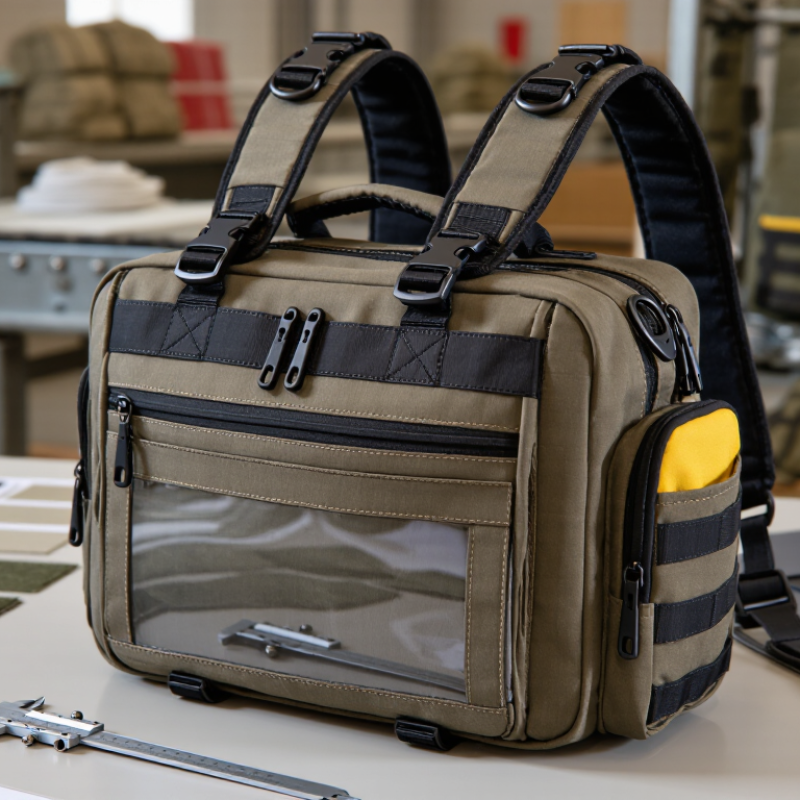
A military courier bag is not defined by appearance alone. Capacity, load control, and fabric performance matter more. A practical daily size is 20–35 liters, enough for documents, clothing, a tablet, and medical essentials. Above 40 liters, the bag may become bulky during vehicle transfers. The 2024 MarketsandMarkets tactical equipment report identifies modular storage and durable textiles as major performance priorities.
Load placement changes everything. Keep dense items close to the back panel, with lighter items outside. A 10-kilogram load can feel unstable when it hangs too far from the body. Padded shoulder straps, a sternum strap, and a removable waist belt improve control. Still, many product descriptions ignore strap adjustment. That is a weakness.
Fabric choice requires compromise. In common field use, 500D nylon reduces weight and works well for moderate abrasion. It suits urban delivery and frequent carrying. 1000D nylon offers a tighter, heavier barrier against scraping and repeated contact. The 2023 Textile Exchange Materials Market Report also shows growing attention to recycled inputs and traceable fiber sourcing. Fabric denier alone proves little. Coating quality, seam construction, zipper protection, and stitching density deserve equal testing. In my experience, a thick fabric can still fail at a poorly reinforced corner. Small details matter.
| Performance Dimension | Typical Specification | Why It Matters in a Military Courier Bag | Selection Consideration |
|---|---|---|---|
| Primary Capacity | Approximately 12–25 L | Provides room for documents, communication equipment, medical supplies, batteries, and personal essentials without becoming excessively bulky. | Choose capacity according to mission duration and carried equipment rather than maximum volume alone. |
| Extended Capacity | Approximately 20–35 L with gussets, expansion panels, or external pouches | Allows the same bag to support short assignments and larger document or equipment loads. | Expansion features improve flexibility but may increase weight, snag risk, and visual bulk. |
| Recommended Working Load | Approximately 5–12 kg, depending on construction and carry method | A controlled load helps preserve stitching, hardware, shoulder comfort, and user mobility. | The working load should be confirmed through prototype testing; volume does not automatically equal load capacity. |
| Fabric Option: 500D Nylon | Approximate fabric mass: 250–300 g/m², depending on weave and coating | Offers a balanced combination of abrasion resistance, flexibility, and moderate weight. | Suitable for daily field use where lower weight and easier folding are important. |
| Fabric Option: 1000D Nylon | Approximate fabric mass: 350–450 g/m², depending on weave and coating | Provides higher resistance to abrasion, puncture, and repeated handling than lighter nylon constructions. | Best for demanding environments, but it normally adds stiffness and overall bag weight. |
| Water Resistance | Water-repellent face fabric, coated backing, storm flap, and covered or waterproof-style zipper | Helps protect paper records, electronics, and medical items from rain and splashing. | Water-resistant is not the same as fully waterproof; seams and closures require separate evaluation. |
| Main Compartment Protection | Padded sleeve or divider with approximately 5–15 mm closed-cell foam | Reduces impact and contact damage to tablets, radios, cameras, or sensitive documents. | Padding should be removable or adjustable when maximum internal capacity is required. |
| Closure System | Heavy-duty zipper, hook-and-loop flap, buckle, or a combined closure | Supports secure transport and helps prevent documents or equipment from falling out during movement. | A combined flap-and-zipper design generally improves weather protection but can slow access. |
| Carry Configuration | Adjustable shoulder strap, carry handle, and optional waist or stabilizer strap | Distributes weight and improves stability when the courier is walking, cycling, or moving over uneven ground. | Wide padded straps reduce pressure; quick-release hardware improves emergency removal. |
| Stress-Point Reinforcement | Box stitching, bar-tacks, reinforced seams, and load-bearing webbing | Concentrated forces occur at handles, strap anchors, flap corners, and attachment points. | Reinforcement should be tested under repeated loading rather than judged only by appearance. |
| Internal Organization | Document sleeve, zippered pocket, pen slots, key retention point, and cable compartments | Separates sensitive materials and reduces retrieval time during delivery or inspection. | More pockets improve organization but reduce usable space and may add weight. |
| Typical Empty Weight | Approximately 0.8–1.8 kg, depending on size, padding, hardware, and fabric weight | A lighter empty bag preserves more of the user's practical carrying capacity. | Compare empty weight together with load rating, reinforcement, and protection level. |
| Best Material Trade-Off | 500D nylon for balance; 1000D nylon for higher abrasion resistance | Material selection directly affects durability, flexibility, pack weight, and long-term comfort. | The most suitable construction depends on terrain, climate, expected load, and frequency of use. |
Note: The specifications shown are typical design ranges for military-style courier bags. Actual performance depends on fabric weave, coating, sewing construction, hardware quality, dimensions, and verification testing.